
How to Write a Eulogy: A Gentle Step-by-Step Guide
Table of Contents
- Start With Memories, Not a Blank Page
- How to Write a Eulogy: A Simple Structure That Works
- How Long Should a Eulogy Be?
- Eulogy Writing Templates You Can Adapt
- Tips for Delivering a Funeral Speech With Confidence
- Common Mistakes When Writing a Eulogy
- When to Ask a Celebrant for Help
- Frequently Asked Questions
Last Updated: October 2, 2026
Start With Memories, Not a Blank Page
Although this page refers to a ‘eulogy’, those who know me will be aware that I often call this a ‘tribute’ instead because it sounds less miserable. You may be writing for a solemn occasion but it’s often a celebration of a life well lived. However, I’m well aware that ‘eulogy’ will be the word which readily comes to your mind at this time, so we’ll stick with it.
The blank page is the hardest part of learning how to write a eulogy. Most people sit down to write and freeze, because they are trying to write a speech when they should be gathering material first.
A eulogy is a spoken tribute that captures who someone was, told through the memories and stories that made them recognisable to the people in the room. Families often find that starting with recollections rather than composition can transform a daunting task into something beautiful.
So before you write a single sentence, spend an hour collecting. Ask siblings, old friends, workmates and neighbours for one memory each. Write down the small things: the terrible singing in the car, the way they always overcooked the sprouts, the phrase they said constantly.
Small details do more work than grand statements. “He never once won a game of Scrabble and never once stopped suggesting we played it" tells a room more than "he was a wonderful man".
Gather Stories From Family and Friends
Reach out to five or six people who knew your person in different settings. Ask each for a single memory and a single quality they would use to describe them. You will often find the same two or three themes appearing again and again. Those recurring threads are your eulogy's backbone.
Find the Thread That Runs Through a Life
Once your notes are gathered, read them aloud. Look for the pattern: was she the one who held everyone together? Was he the one who made people laugh when things were hard? A eulogy with one clear thread feels honest and whole. A list of unrelated facts does not.
How to Write a Eulogy: A Simple Structure That Works
A eulogy has three parts: an opening that introduces who the person was, a middle that shares memories and stories, and a closing that says farewell and thanks the room for coming. Keep the structure simple and let the content carry the weight.
This structure is often recommended to families, and it works because it mirrors how we naturally talk about someone we have lost.
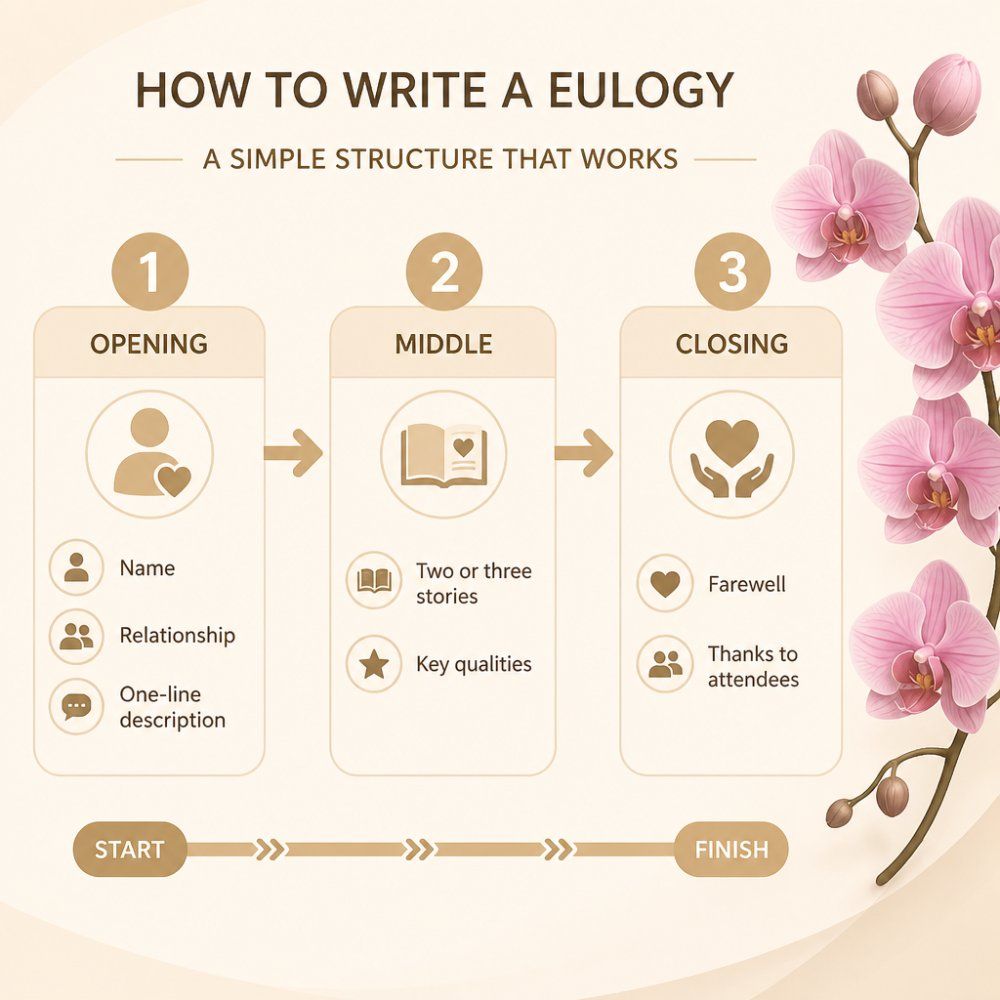
Opening, Middle and Closing
- Opening: Introduce yourself and your relationship, then describe the person in a sentence or two. "I'm Sarah, Ruth's daughter. Mum was the person who remembered every birthday in this room and never once let anyone leave hungry."
- Middle: Two or three stories that show their character. One story per quality you want to highlight. Keep each story short and specific.
- Closing: A direct farewell, followed by thanks to everyone for coming. This is where you can speak to the person directly if it feels right: "Rest well, Dad. We'll take it from here."
How Long Should a Eulogy Be?
A eulogy should run between three and five minutes, which is roughly 450 to 750 words when spoken at a natural pace. That length gives you room for a proper tribute without losing the room.
Most people overestimate how long they can comfortably speak. At a funeral or memorial, emotions run high, and a shorter eulogy delivered with feeling lands better than a long one delivered through tears. If several people are speaking, aim for the shorter end.
A useful test: read your draft aloud with a timer. Bear in mind that nerves tend to speed up the words you speak on the day. If you finish under three minutes, you have room to add one more story. If you are past five, cut the weakest anecdote rather than speeding up.
Eulogy Writing Templates You Can Adapt
Templates give you a scaffold when your own words will not come. Use the one below as a starting point, then replace every placeholder with your own details.
[Opening] I'm [your name], [relationship] to [name]. [Name] was [one sentence describing them].
[Early life or background] [Name] was born in [place] and [one or two sentences about their early life, work or family].
[First memory] One thing I'll always remember is [specific memory]. [Two or three sentences of detail.]
[Second memory] [Name] also [another memory or quality]. [Detail that shows their character.]
[What they meant to others] To [family members or friends], [name] was [description]. [One sentence about their impact.]
[Closing] [Name], thank you for [specific thing]. We will miss you. Thank you all for being here today to remember [name].
Adapt the tone to fit the person. A template is a starting point, not a script. If a line feels wrong for your person, change it or cut it. The best eulogies sound like the person being remembered, not like a form letter.
Tips for Delivering a Funeral Speech With Confidence
Delivery matters as much as the words. Print your eulogy in large, clear type, double-spaced, on one side of the paper only. Number the pages in case you drop them.
Stand close to the lectern and take a breath before you begin. Pause whenever you need to. Nobody in that room is timing you or judging a stumble. If you cry, that is not a failure; it is part of the tribute.
Ask someone you trust to stand nearby as a backup reader, in case you cannot continue. If you’ve asked me to conduct the service, you’ll know i’ve already offered to be that person. Knowing that support is there often makes it easier to carry on.
Read your eulogy aloud to one person at least once before the day itself. Hearing it in your own voice, with an audience of one, catches awkward phrases and gives you a sense of where the emotional pauses will land.
Common Mistakes When Writing a Eulogy
The most common error is trying to include everyone's memories. A eulogy is a tribute, not a minutes-of-meeting record. Pick the stories that best capture who the person was and let the rest live in conversations afterwards.
Other pitfalls to avoid:
- Inside jokes nobody else will understand. If only three people will laugh, it belongs in a private conversation, not a public tribute.
- Airbrushing the person. A eulogy that describes a saint nobody recognises doesn’t ring true. Gentle honesty about their quirks and faults makes the tribute land properly and will have people nodding and smiling.
- Reading a list of achievements. The eulogy is for the person behind those achievements.
- Writing for the wrong audience. Write for the people in the room: family, friends, colleagues. Not for an imagined critic. The people there have come to pay their respects.
When to Ask a Celebrant for Help
You do not have to write or deliver the eulogy alone. A celebrant can help you shape the words, structure the tribute, or deliver it on your behalf if speaking feels impossible.
I’m an experienced celebrant. I hold the Level 3 Diploma in Funeral Celebrancy (QCF), the highest national qualification for the sector. I bring over 45 years of experience supporting people in distressing circumstances, including time as a Coroner's Officer. Funeral directors and crematorium staff often describe me as a ‘safe pair of hands’, and that reputation is built on taking the time to understand who your person actually was.
If you are considering celebrancy yourself, I also offer an independent celebrancy consultation for people weighing up a career change to this life. I have no financial connection to any training provider and have no course to sell you. However, I do believe that prospective celebrants deserve the opportunity to ask difficult questions of someone working in the sector and - crucially - of someone who has no financial interest in whether they then go on to train. I’ll simply offer an independent, completely honest perspective.
Losing someone leaves a gap no words can fill, but a eulogy written with care can honour them properly. If the task feels too heavy to carry alone, Mary Hopes Experienced Professional Funeral Celebrant can help you find the right words or deliver them for you, with a Level 3 Diploma in Funeral Celebrancy, over 45 years of experience, and a personalised approach built around your person.
Frequently Asked Questions
What should be included in a eulogy?
A eulogy works best when it captures who the person was, not just what they did. Include their name and relationship to you, a few specific memories or stories that show their character, the qualities people knew them for, and a closing farewell or thank you. Small, particular details land better than grand statements. A story about them burning the Sunday roast every week will move people far more than saying they were a wonderful cook.
How long should a eulogy be?
Around three to five minutes is the usual guide, which works out at roughly 450 to 750 words when spoken at a steady pace. That is long enough to say something meaningful without testing the room. If several people are speaking, aim shorter, around two to three minutes each. Always read it aloud with a timer before the day, as nerves tend to slow delivery down.
Can a eulogy be funny?
Yes, and often it should be. Gentle humour is one of the kindest things you can offer a grieving room, and a shared laugh can release tension better than anything else. The test is whether the person themselves would have laughed. If the answer is yes, keep it in. Avoid jokes at the expense of others, and steer clear of anything that would embarrass family members hearing it for the first time.
How do I cope with nerves when delivering a eulogy?
Prepare more than you think you need to. Print the eulogy in a large, clear font with double spacing, and read it aloud at least three times beforehand. On the day, pause before you start, take a breath, and look up at the room once. If you cry, that is completely fine. Stop, breathe, take a sip of water, and carry on. Most celebrants will happily stand beside you for support if you ask. If you really can't bear to catch anyone's eye, fix your gaze at a spot on the back wall - a clock or a picture for example - and talk to that instead.